Jemez Hot Springs: Which Springs to Visit in New Mexico
Compare Jemez hot springs from primitive travertine pools to developed mineral baths, with trail lengths, water temperatures, and drive times between them.
On this page
The Jemez Valley is the rare place where you can walk a half-mile to a set of travertine pools in the morning and drive to a developed mineral bath by afternoon, all within a single canyon of the Santa Fe National Forest. That range makes it the best soaking corridor in New Mexico for travelers who want options rather than a single destination. Whether you have a day or a weekend, the choice comes down to effort: short uphill hike to primitive pools, a longer forest-road trek to a high hillside soak, or a drive-up resort with maintained baths.
The springs cluster around the village of Jemez Springs and along Highway 4, the two-lane road that threads the valley between La Cueva and Battleship Rock. From Albuquerque, the drive takes roughly an hour and a half depending on traffic and the route through Bernalillo and Jemez Pueblo. Spring runoff and winter snow can change road and trail conditions, so start with the village itinerary page at jemezsprings.org before you commit to a plan. You can also browse the broader hot springs in new mexico guide to see how the Jemez soaks fit into a longer state road trip.
Why the Jemez Valley Is New Mexico's Best Soaking Corridor
Few regions in the Southwest pack this much variety into such a short stretch of road. Within a half-hour drive on Highway 4 you can choose between a roadside travertine soak, a hillside primitive pool reached by a forest-road hike, and a historic resort with multiple mineral baths. The village of Jemez Springs itself has a walkable core with shops and eateries, and the Jemez Historic Site sits just down the road for a non-soaking break. That combination of accessibility and wild country is why the valley draws everyone from day-trippers to weekend campers.
The trade-off is that the most popular primitive springs get crowded on weekends, especially the ones with short approaches. If you want solitude, you need to either arrive early on a weekday or commit to the longer hike to the high-elevation pools. The valley rewards planning: pick your soak by the effort you are willing to spend, then build the rest of the day around it.
Where Jemez Springs Is and How You Get There
Jemez Springs sits in Sandoval County along Highway 4, about 60 miles northwest of Albuquerque via Bernalillo and Jemez Pueblo. The drive climbs through the Jemez River valley and passes the village before continuing east toward Battleship Rock and the Valles Caldera. From Santa Fe, the route typically goes through Los Alamos or down Highway 4 from the north, and both approaches are scenic mountain roads with curves and occasional livestock. Fuel up before you leave the metro area, because services in the valley are limited to a few small stores.
Highway 4 is the main artery for every spring in this guide, and the signed Forest Service pullouts along it are your access points. The road is paved and generally well maintained, but winter storms can leave ice and snow, and the higher forest roads that serve the more remote soaks close seasonally. For a side trip on the way in or out, the hot springs near santa fe page covers soaks on the eastern side of the mountains.
The Primitive Springs: Spence Hot Springs
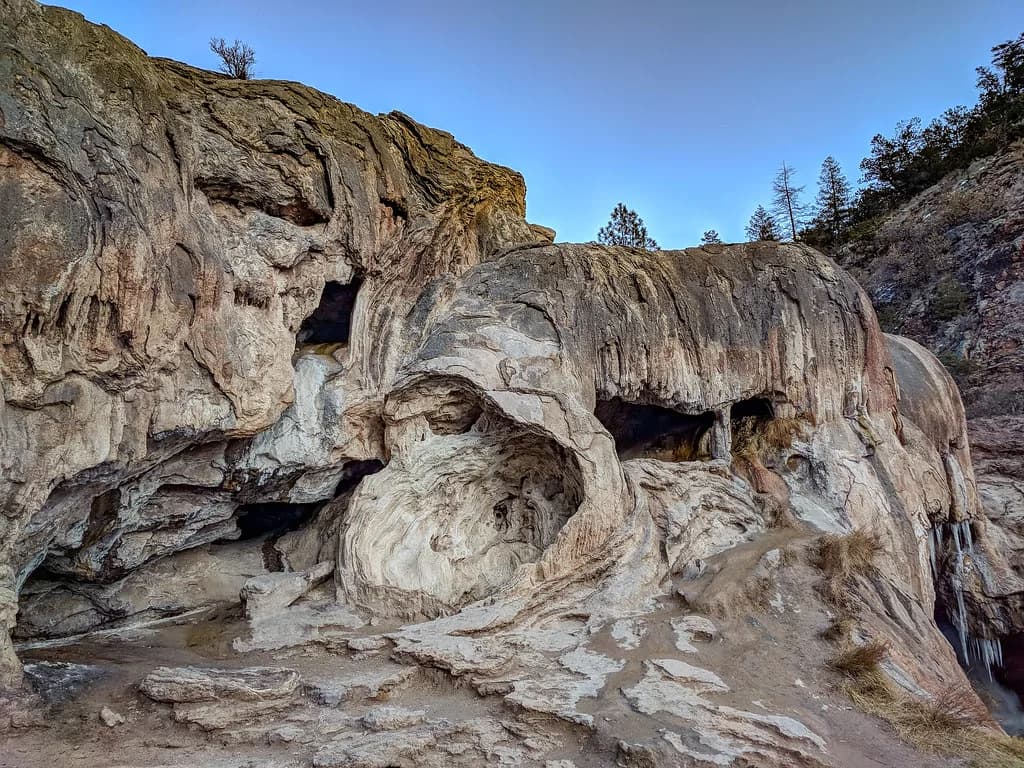
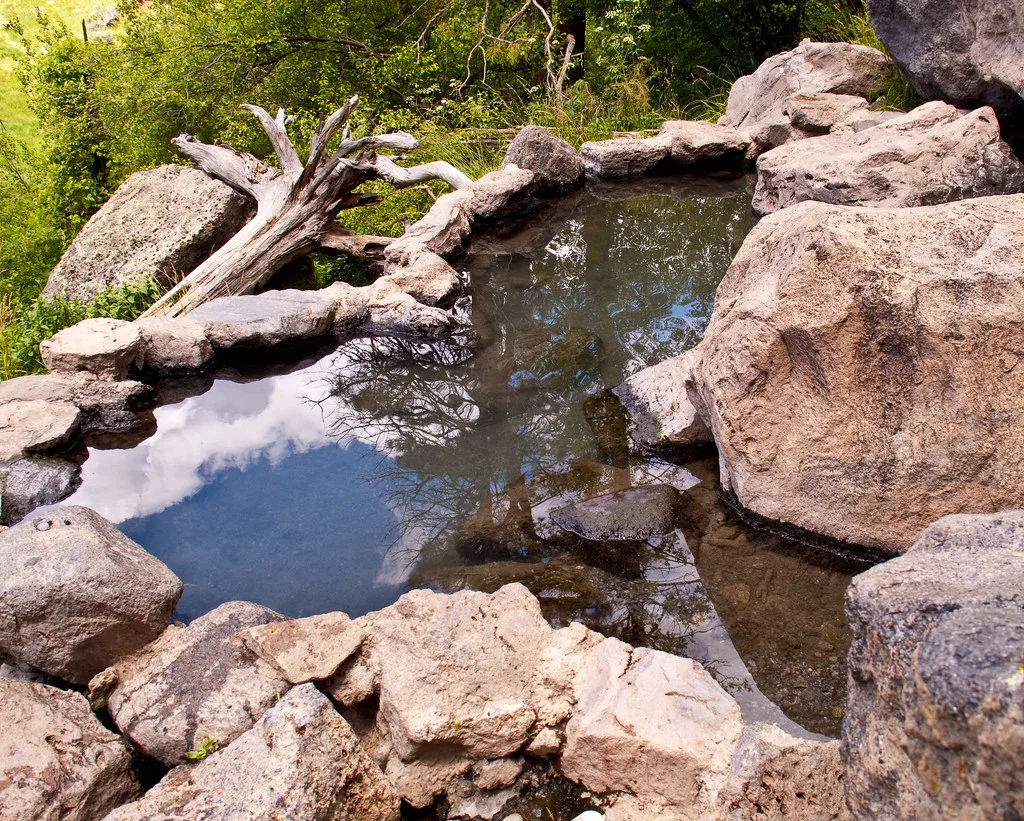
Spence Hot Springs is the most accessible primitive soak in the valley: three travertine-lined pools perched above the East Fork Jemez River with views down canyon toward Battleship Rock. The pools step down the hillside, with the hottest water at the source vent and progressively cooler basins downstream, so you can pick your temperature by moving a few feet. Expect 98–105°F depending on the pool and the season, and plan to sit where the water feels right rather than expecting a uniform soak.
The small pullout on Highway 4 fills by 10 a.m. on weekends, so arrive early or plan a weekday visit, and have a backup soak in mind.
Access is a signed Forest Service pullout on Highway 4 between La Cueva and Battleship Rock, followed by a half-mile uphill walk that takes most people 10 to 15 minutes. The trail is moderate and the pullout is small, so on weekends the lot fills by 10 a.m.; if you arrive later, have a backup soak in mind. The Forest Service requires clothing at these pools, and there are no facilities or trash cans, so pack out everything you bring in. For a full breakdown of the layout and approach, see the spence hot springs guide.
The Primitive Springs: San Antonio Hot Springs
San Antonio Hot Springs is the valley's high-elevation option, a set of terraced stone pools on a hillside above the San Antonio River fed by a steaming vent that spills into successive basins. Water temperatures run roughly 100–108°F depending on which pool you choose, and the upper pools sit closest to the vent. The setting is wilder and quieter than Spence, but the approach is much longer: roughly a 5-mile round trip on Forest Road 376, which closes in winter. That closure makes San Antonio a late-spring-through-fall destination, and you should treat the road status as a hard planning constraint rather than a footnote.
Forest Road 376 closes in winter, so check the road status before committing to the forest-road approach.
Because the hike is longer and the elevation higher, bring layers, more water than you think you need, and sturdy shoes for the rocky forest road. The pools are primitive, so pack out everything and leave the stone edges as you found them. For route details, see the san antonio hot springs page, and for the land manager's current road and trail status, check with the Santa Fe National Forest before you drive up.
Developed and Commercial Soaks in the Valley
If you want a drive-up soak with maintained facilities, the Jemez Valley has developed options alongside the primitive pools. The village's own hot springs and spas range from natural springs to maintained indoor and outdoor pools, as the town's itinerary page notes, making the village a practical base if you are traveling with people who prefer a shorter walk from the car. These are the soaks to choose when you want a changing room, a posted temperature, and a shorter approach.
For a full resort experience, Ojo Caliente Mineral Springs Resort & Spa lies west of the valley and has been operating since 1868. It offers 11 pools fed by four distinct mineral types, a day pass, and a strict no-phone deck policy, and its day-pass price is published by the resort. See the ojo caliente hot springs guide for current pricing and booking details. The trade-off is cost and formality versus the primitive pools: you pay for the amenities, but you get reliability and a shorter walk.
Water Temperatures and What They Mean for a Soak
Water temperatures across the Jemez springs range from the high 90s to about 108°F, and the variation matters more than any single number. At Spence, the source vent is the hottest point and the downstream pools cool as they spread, so you can regulate your soak by choosing a basin. At San Antonio, the upper terraces near the vent run hotter than the lower pools, and the difference is enough to change how long you stay in.
| Soak | Temperature | Approach |
|---|---|---|
| Spence Hot Springs | 98–105°F | Half-mile uphill walk from a signed pullout |
| San Antonio Hot Springs | About 100–108°F | Roughly 5-mile round trip on Forest Road 376 |
| Ojo Caliente Mineral Springs Resort & Spa | — | Resort with 11 pools and a day pass |
Geothermal water is not treated, and the standard practice is to avoid submerging your head in it. The travertine edges at Spence are fragile and can collapse near the vents, so stay on the stone trail and keep your footing. If a pool feels too hot, move downstream or to a lower basin rather than waiting it out.
Access, Parking, and Winter Road Conditions
Parking is the biggest practical constraint at Spence: the signed pullout on Highway 4 is small, and on weekends it fills by mid-morning. Arrive early or plan your visit for a weekday. At San Antonio, the parking area sits at the end of Forest Road 376, and the road closes in winter, which pushes the soak into the late spring through fall season. Carry chains or traction devices in shoulder seasons if you are driving the higher roads, and check conditions before committing to the forest-road approach.
Highway 4 itself is paved and usually plowed, but winter storms can still leave ice on shaded curves. Cell service is spotty through the valley, so download maps before you leave the metro area. If the Spence lot is full, the village of Jemez Springs is a short drive away with developed soaks and services.
Fees, Hours, and What Each Soak Costs
Spence Hot Springs is a free Santa Fe National Forest site, with parking limited to daylight hours and no permit required beyond the parking-pass requirement, according to Hot Springs Atlas. A donation is encouraged, and the pools are walk-up friendly with no reservation system. Check the forest's official Spence page or the Atlas listing for the current status of the parking area before you go.
Ojo Caliente publishes a day-pass price on its own site, and that is the number to plan around for the resort stop on your loop. For the primitive springs other than Spence, fees and reservation policies are set by the Santa Fe National Forest, which manages the land. A primitive spring is not automatically free; the Santa Fe National Forest's own pages list what each site charges.
Camping and Lodging in the Jemez Valley
The village of Jemez Springs is the natural base for a weekend of soaking, with a small cluster of lodges and retreat centers and a handful of restaurants within walking distance of the highway. Camping options in the surrounding Santa Fe National Forest include developed campgrounds and dispersed sites, though you should confirm open status and any fire restrictions with the forest before you rely on them. The town's camping and overnight itinerary pages at jemezsprings.org are a good starting point for both.
If you want to combine the Jemez soaks with a resort stay, Ojo Caliente is a reasonable overnight add-on, and Truth or Consequences makes sense if you are extending the trip south toward the Rio Grande. For a wider menu of bases, see the hot springs in new mexico guide.
Crowds: Best Time of Day and Season
Weekday mornings are the most reliable window for the primitive pools, especially Spence, where the small lot dictates how many people can be on the trail at once. Midweek and shoulder-season visits are typically quieter, while summer weekends bring the heaviest traffic to both the springs and the village. May through October is the practical season for the higher-elevation San Antonio soak, since Forest Road 376 closes in winter.
If you are visiting on a summer weekend, plan your soak for early morning and use the afternoon for the Jemez Historic Site or a drive up to Valles Caldera. That sequencing avoids the worst of the parking crunch and gives you a backup plan if the pullout is full.
Building a Jemez Springs Road Trip Around the Soaks
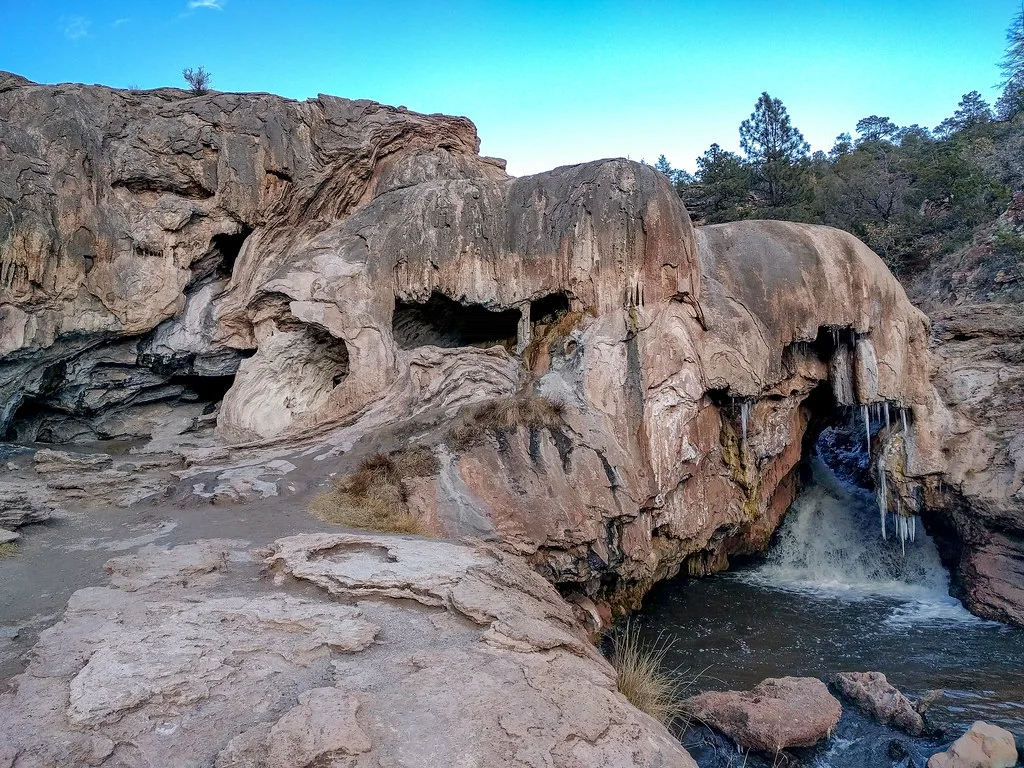
A practical weekend starts with an early weekday or Saturday-morning soak at Spence, followed by lunch in the village and then a drive up Highway 4 toward Battleship Rock. On day two, hike into San Antonio if the road is open and the weather is stable, or take the easier route with a developed soak in the village. If you have a third day, add Ojo Caliente on the way back toward the Rio Grande.
Base your nights in Jemez Springs to avoid a long dark drive back to Albuquerque after soaking. The village itinerary page lists day-trip and overnight plans you can adapt, and the hot springs page covers the range of developed options in town.
Nearby Soaks Worth Adding to the Loop
Beyond the Jemez Valley, Ojo Caliente is the most substantial resort add-on, with 11 mineral pools and a day-pass option that makes it a realistic stop on a longer loop. Farther south, Truth or Consequences has a cluster of riverside soaks along the Rio Grande, including Riverbend Hot Springs, which pairs tiled pools with a downtown base. Both are worth a night if you are extending the trip, and if your loop crosses into neighboring states, the Utah hot springs guide covers the same choice between developed resorts and wild soaks.
On the eastern side of the mountains, santa fe hot springs covers the soaks within reach of the capital, and the hot springs in new mexico guide maps the rest of the state's options. Plan your loop so the driving stays under two hours between stops, and treat each spring as its own half-day rather than trying to fit three into one afternoon.
Leave No Trace at the Primitive Pools
At Spence and San Antonio, there are no facilities and no trash service, so everything you carry in has to come out with you. Stay on the established stone trails, keep your gear off the fragile travertine edges, and do not move rocks to build new pools or dams. Pack out food scraps and wrappers, and keep dogs leashed where the Forest Service requires it, particularly at Spence. A short, disciplined visit keeps these springs worth returning to.
Plan Your Visit
The Jemez Valley gives you a genuine choice: a short uphill hike to the travertine pools at Spence, a longer forest-road trek to the high terraces at San Antonio, or a drive-up soak at a developed spring in the village. Pick by the effort you want to spend and the season you are traveling, then build the rest of the day around the village and Highway 4. Book overnight stays in Jemez Springs or at a resort like Ojo Caliente, and check current road and trail conditions with the Santa Fe National Forest before you drive the forest roads.
Frequently Asked Questions
What hot springs are near Jemez Springs, New Mexico?
The main soaks in the Jemez Valley are Spence Hot Springs, a short uphill walk to three travertine pools, and San Antonio Hot Springs, a high-elevation primitive soak reached by a longer forest-road hike. The village of Jemez Springs also has developed hot springs and spas, and Ojo Caliente Mineral Springs Resort & Spa lies west of the valley as a full resort option.
How far is the hike to Spence Hot Springs?
The walk from the signed Forest Service pullout on Highway 4 to the pools at Spence is about 0.7 miles uphill, which takes most people 10 to 15 minutes at a steady pace. The trail is moderate and climbs steadily, so wear shoes with grip and carry water. The pullout between La Cueva and Battleship Rock is small and fills by mid-morning on weekends.
What is the water temperature at Jemez hot springs?
Spence Hot Springs runs roughly 98–105°F depending on which of the three pools you choose, with the hottest water at the source vent and cooler basins downstream. San Antonio Hot Springs runs about 100–108°F, with the upper terraces near the vent hotter than the lower pools. Move between basins to find a temperature that suits you rather than staying in water that feels too hot.
Are Jemez hot springs free?
Spence Hot Springs is a free Santa Fe National Forest site with parking limited to daylight hours; a donation is encouraged and no reservation is required. The developed springs in the village and resorts like Ojo Caliente charge their own rates, and the higher-elevation forest roads may have their own access rules.
Can you camp near Jemez Springs hot springs?
The village of Jemez Springs has lodges and retreat centers that make a convenient base, and the surrounding Santa Fe National Forest has developed campgrounds and dispersed camping options. Confirm open status and any fire restrictions with the forest before you rely on a site. Camping near the springs is the simplest way to soak early before the weekend crowds arrive.
When is the best time to soak in the Jemez Valley?
Weekday mornings and the shoulder seasons are the quietest times, especially at Spence, where the small parking lot fills by mid-morning on weekends. May through October is the practical window for San Antonio Hot Springs because Forest Road 376 closes in winter. Summer weekends are the busiest, so plan an early soak and use the afternoon for the village or Valles Caldera.
Which Jemez hot springs are easiest to reach?
Spence Hot Springs is the easiest primitive soak, with a 0.7-mile uphill walk from a signed Highway 4 pullout. The developed springs and spas in the village of Jemez Springs are drive-up options with shorter approaches, and Ojo Caliente is a full resort with maintained pools and facilities. San Antonio is the most demanding, requiring a roughly 5-mile round-trip hike on a forest road.
What should you bring to the primitive Jemez pools?
Bring shoes with grip for the rocky and travertine trails, more water than you expect to need, and layers for the higher-elevation San Antonio hike. Pack out everything you carry in because there are no facilities or trash service at the primitive springs. A towel, a dry bag for your phone, and cash for a donation at Spence round out the kit.
Sources
Hot springs notes for your next road trip
Optional updates when we add or revise hot springs guides.
You might also like
Continue reading
More guides you'll find useful